Saturday, 21 August 2010

Kalendar over Ordo Missae?

It has been interesting of late to read on various blogs [Patricius, Rubricarius, Fr Hunwicke], the questions pertaining to Kalendar and Tradition.  A great many "pro-tradition" believe the old (pre'62) Roman General Kalendar is supremely preferably to the present (1969/71).  Yet a question perplexing me is, how is the traditional liturgy to develop organically if the Kalendar is to be staid?

Not that I think this a perfect solution at all, but for almost a year now in the ORCCE we have been experimenting with using the current General Kalendar yet maintaining the traditional liturgy. We retained the observance of Solemnities on their traditional dates and observed the cherished Octaves (e.g. Pentecost), Gesima and the pre'55 Holy Week. We observed the "new" dates for Saints Days and retained observance of those Saints not in the current General Kalendar (not easy but I don't think we've repeated anyone yet).

We did this as a deliberate attempt to express a visible spiritual communion with the Holy Father - who for us, despite his disavowal of the title - remains our "Patriarch" and indeed the universal Pope; it seems only right (and traditional) to offer the same "Office of the Day" (Hours & Mass) as him?!

We considered that the Missal and/or Kalendar does not itself make the Mass i.e. that the Rite of Mass is not the Missal but the Ordo contained in the centre. That said, we did not subsitute the new Propers for the traditional, rather we continued using the prayers and Scripture of our forefathers, all we did was change the dates and for those later Saints use the traditional Common Propers appropriate to their designation i.e. Martyr, Confessor etc where there was not a "traditional" option already proffered.

Re the Office, we have a mix of some Clergy using the traditional Breviary and some the Liturgy of the Hours. Surprisingly, a sense of harmony can still be maintained, most easily for the Breviary of course (to the traditional Propers) but even in the new Office, the main themes have not been lost. Having a mixture of Clergy, some of whom retain secular employment to sustain themselves and their ministry, the LOH has proved the easier Office for them, naturally. That said, those used to the traditional Breviary have found no change.

We are soon coming to the end of our experiment and must needs soon decide how to proceed for the approaching new liturgical year. Whilst it would be wholly easier to follow one Rite and one Kalendar, and just pick an "editio" we wonder how that would express communion with the Church past and present?

Thursday, 22 July 2010

"Independent Catholicism"

What Old Roman Catholicism is expressly NOT is any form of “Independent Catholicism”. (The educated reader will no doubt be aware that the phrase “Independent Catholicism” is an “oxymoron”!) Yet this is a phrase used by many as a cover all for those who claim to be Catholics supposedly independent of any historic See.

It is true that many denominations calling themselves “Old Catholic” and not members or having recognition from the Utrecht Union of Old Catholic Churches, have no connection to any historic See – either in the derivation of their Orders or indeed, in the history of their foundation. However, Old Roman Catholicism understands itself to be a continuation of Western i.e. Roman Catholicism as maintained by the historic and original See of Utrecht, prior to the First Vatican Council. When Pope Pius IX instituted a new heirarchy in Holland and withdrew recognition by the Holy See of the already existing bishops, the original See of Utrecht became to be regarded and later known as the “Old Roman Catholic Church of the Netherlands”.

When other disaffected Roman Catholics on the continent formed a Conference and called themselves “Old Catholics” shortly after the First Vatican Council, they asked for episcopal oversight from the original See of Utrecht. Later this Conference formed itself into a Union, the “Utrecht Union of Old Catholic Churches” with representative national churches as members but giving the See of Utrecht primacy, acknowledging the seniority of her bishops. Over time however, this Union began in its Conferences to adopt un-Catholic theologies and practices. When Arnold Harris Mathew accepted consecration from the See of Utrecht in 1908, that See had yet to adopt the various changes both liturgical and doctrinal, that the Old Catholics were advocating.

By 1910 however, the See of Utrecht capitulated and adopted the new culture and thinking of the Union, thus ceasing to be a continuation of Old Roman Catholicism as it had originally maintained it, even adopting the nomenclature “Old Catholic”. It was at this point that Monsignor Mathew declared the independence from Utrecht of the regional missionary territory of Great Britain that had been his charge from the See of Utrecht to found and administer. Archbishop Mathew then proceeded to continue the faith and praxis of Western Catholicism as it had originally been maintained and continued by the Old Roman Catholic Church of Utrecht up to this point. Thus the churches who maintain this same faith and praxis as originally maintained by the See of Utrecht are known as “Old Roman Catholics.”

Arguably, and if there had been a movement within the Dutch Church to continue this orthodox faith and praxis in Holland, there might have been another claim to be a “continuation” of the See of Utrecht. As it was, the adherents of Old Roman Catholicism recognised that more important than a claim to be the continuation of any historic See, was the necessity of maintaining the true Catholic faith as it had been practised prior to the declaration of Papal Infallibility. As Archbishop Mathew had been mandated to uphold, defend and preserve this faith at his consecration, and having been duly appointed and given jurisdictional authority by the See of Utrecht, to found, serve and administer a church in Great Britain to this end, no further authority was required for him to pursue his charge. As providence would have it and despite the efforts of many detractors during his lifetime, Msgr Mathew was able to preserve the historic (Old) Roman Catholic faith as it had been received in the Western Catholicate, and through the efforts of successive Old Roman Catholic bishops carefully consecrated in and preserving his Apostolic Succession and teaching, the Old Roman Catholic faith has continued to this present day.

Old Roman Catholicism is no more “independent” than any Eastern Orthodox Church or Patriarchate maintaining that deposit of "the faith once delivered to the saints” [Jude 1:3]. As for the charge of being unrelated to an historic See, Old Roman Catholics are in exactly the same position as are English Roman Catholics seperated from the originally Catholic metropolitan See of Canterbury. We are seperated only by virtue of history and our adherence to the original practice of the Catholic Faith from either the See of Utrecht or indeed, the Holy See. In both cases, it was not “us” who changed, but the historic Sees from whom we are descended who altered their practice of the Catholic Faith from what they in turn had received; the Holy See by promulgating Papal Infallibility and the See of Utrecht by adopting Protestant beliefs and practices.

Tuesday, 13 July 2010

Of Bishopesses...


Well the inevitable happened, the Church of England confirmed it's desire this past weekend to renounce Catholic praxis and teaching entirely. No more the fudge of classical Anglicanism of being both "Reformed and Catholic" instead, just "Protestant". The residual vestiges of its once Catholic past will remain, the use of titles like "Bishop," "Cathedral," "Priest," "Eucharist" etc, but devoid of all their original, contextual and historical etymology. The "period of reception" i.e. experimentation of women priests now over, General Synod has progressed to the next, perhaps logical stage, of consecrating women as bishops.

Naturally I genuinley feel for those who had "hoped beyond hope" that this decision by General Synod would not be taken. But, frankly, it was inevitable. Why? Simply because the Church of England has perceptibly grown more and more secularist in its ideas and agenda and has become less and less like a Church in its governing policies and structures. The bishop of Durham (who will relinquish his bishopric tomorrow) said today that, "the day the Church stops listening to God and follows the powers of this world is the day when the Church ceases to be Church!" His Lordship of course, has hit the proverbial nail squarely on the head.

The problem is and has been in the Church of England, that many (notably not all) Christians desirous to re-present Christianity anew to the present generation, believe that modern secular approaches to social and moral problems are the same or even better than a traditional Christian approach on the same issues. In their attempt to make churches less "staid" they adopt popular secularist and humanist ideaologies. So it was that during General Synod's deliberations, the "pro-lobby" appealed to the "law of the land" regarding equal rights, rather than Scripture or Apostolic Tradition!

Wednesday, 26 May 2010

Of liturgical changes... the Pentecost Octave

The following is a story recounted by Fr Z and attributed to the MC mentioned in the retelling of this account of Paul VI on the Monday morning after Pentecost Sunday, 1970...
...His Holiness Pope Paul VI rose bright and early and went to the chapel for Holy Mass. Instead of the red he expected, there were green vestments laid out for him.


He queried the MC assigned that day, "What on earth are these for? This is the Octave of Pentecost! Where are the red vestments?"


"Santità," quoth the MC, "this is now Tempus ‘per annum’. It is green, now. The Octave of Pentecost is abolished."


"Green? That cannot be!", said the Pope, "Who did that?"


"Holiness, you did."And Paul VI wept....
Those of you who watch the Daily Mass Online, may have noticed the Commemoration of the Pentecost Octave including the change of the Last Gospel from the Prologue of St John to the Gospel of today's Feria in the Octave of Pentecost; this despite our celebrating the Feast of St Philip Neri, an important Patron of my Congregation.  Could not the Holy Father have made such an accomodation after realising his mistake...?

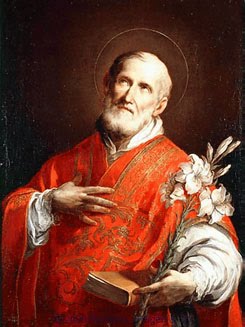
St Philip Neri; Spiritual Founder of the Congregation of the Oratory

Co-Patron of the Oratory of St John Vianney


Rome in the 1530s was a city struggling to recover after the sack of 1527, a place of poverty, material, moral and spiritual. In particular, the clergy were at a low ebb, often living and behaving disreputably. By the end of the century, all this had changed, and this was largely through the work of St Philip Neri.


Philip came to be known as the 'Apostle of Rome', but was born in Florence in 1515. Turning his back on a career in business with his uncle in Monte Cassino, he arrived in Rome in 1535, a city where, apparently, he had no prospects and knew nobody. So how did he come to wield the influence he ultimately did? He started his life in Rome teaching the two sons of a Florentine compatriot, in return for a room and food, and a place to study. This allowed him the time and freedom for his intense life of prayer to grow. He used to spend many hours, even whole nights praying, sometimes in church porches, sometimes in the catacombs of San Sebastiano outside the city. It was here, on Pentecost Sunday in 1544, that Philip experienced his own Pentecost. As he reluctantly confided many years later, it appeared to him that a globe of fire had descended from heaven and penetrated his heart, so that for the rest of his life he could feel it palpitating, throbbing with divine Love. An examination after his death confirmed his heart to be abnormally large, so much so that it had forced two ribs apart to make space for it.


Philip's prayer bore practical as well as spiritual fruit. 'When shall we begin to do good?', he used to say, and, over the years he gathered together a group of people who, after meeting Philip, did indeed want to do something worthwhile. A particular area where help was badly needed was in the grim hospitals of Rome, where patients were dependent on volunteers for basic nursing, cleaning and food. In the Jubilee year of 1550, many poor pilgrims made their way to Rome, and Philip and his companions in what they called the Confraternity of the Holy Trinity made it their business to care for their needs too. That year, Philip was persuaded - somewhat reluctantly - to be ordained a priest, which duly happened on 23rd May 1551. After this, he found a home at the church of San Girolamo della Carita, where he and his companions used to meet informally for prayer, discussion, and recreation together, before going off to minister to the needy. Soon, large crowds were coming to these gatherings, so Philip devised a pattern for them: four talks, some music, and vocal prayers. And so what we would recognise today as the Oratory was born.


Philip's success aroused jealousy in some quarters: he and the Oratory were subjected to more than their fair share of suspicions and difficulties, but throughout it all he remained faithful to his own advice, non dubitare, 'don't worry', confident that God, who had begun the good work in him, would bring it to completion. And his trust paid off: a rather dilapidated church, Santa Maria in Vallicella, was given to the Oratory by the Pope, and it was rebuilt on a grand scale: even today, it is still known as the Chiesa Nuova, the New Church. Some of Philip's companions had been ordained to assist him in his ministry, and together they were organised into the Congregation of the Oratory.


St Philip died on 25th May 1595. By that time, he had become the friend and confessor of countless people, including Popes and Cardinals (and had himself refused a Cardinal's hat). He used, even in old age, to spend many hours in the confessional, bringing pardon and peace to all who came to him: his penances were perfectly suited to the needs of his penitents, and never harsher than they could bear. He was always available to those in need, and used to say that the porter's bell was to him like the voice of God. He saw what others might regard as these distractions from prayer as 'leaving Christ for Christ'. Above all, perhaps, he is known for his joy in the service of Christ: the attractive character of the 'Saint of Joy' brought people flocking to him, and through him to a renewed vigour in faith. His practical jokes and eccentricities were many: whether he was sending the future Cardinal Baronius to taste countless different wines before buying the smallest amount possible of one, organising a procession of noblemen carrying pots and pans through the streets to the Chiesa Nuova, or shaving off half his beard, his aim was simple: to change Rome for the better, to draw everyone he could closer to Christ, to allow others to share in something of that joy which he himself experienced.


O God, as you never fail to enrich your faithful servants with holiness,
grant, we pray, that we may be filled with the same Spirit
which so wonderfully penetrated the heart of St Philip.
We ask this through Christ our Lord. Amen.

Friday, 23 April 2010

"For England and St George!" Henry V

"Carissime: Memor esto, Dominum Iesum Christum"
Beloved: Fix thy mind on Christ II Tim 2:8

So began today's epistle reading for the feast of St George, Principal Patron of England, that great saint who so inspired England to be "great"... From Good King Richard I, the "Lion heart" who granted release to prisoners who would wear it and dedicated his crusading armies to the Cross of St George, through that other great King immortalised by Shakespeare, Henry V who cried "For England and St George" at Agincourt to those great personages honoured most highly by our monarch as members of the Royal Order of the Garter, of St George. Yet so little and yet so much is known about St George... little for certain, but much in the way of legend. Yet I believe a fair balance of the two may yet convince one, as it seems it has the majority of the Church Catholic for centuries as well as our monarchs, that "George" did indeed exist.

The oldest and most popular legend of St George is widely held by the Church of the East who claim him particularly as one of her sons. Believed to have been a soldier in the Roman Army serving the tyrannical Emperor Diocletian, it is said that George was beheaded for standing up to the Emperor against the persecution of Christians. The great ecclesial historian, St Eusebius of Caesarea, records such a soldier of fame being thus martyred writing in 322AD, a soldier of noble-birth martyred under Diocletian at Nicomedia on April 23rd 303AD though this otherwise detailed scribe does not give the name, country or place of burial of the martyr! That said, an apocryphal legend called the "Acts of St George" widely circulated from the Fifth Century by the East confers with these details, adding only the soldier's rank of "Tribune". These accounts were later translated into Anglo-Saxon adding the Saint's visits to Caerleon (outside Newport) and Glastonbury, also recounting the slaying of the dragon. A later collection of legends known as the "Golden Legend" (Legenda Aurea) by James of Voragine in 1265 includes the most famous account of "George and the Dragon" which every schoolboy used to know in England!

It has been suggested that Arculpus (an avant pilgrim of the 7/8C) and St Adamnan (of Mayo) brought the translated "Acts of St George" to these Isles and the Saint quickly caught on in the minds and hearts of the people. But it was really the Crusades that would establish St George as the patron of England. The Crusades were, in part, an outlet for an intense religious piety which rose up in the late 11th century among the lay public. The specific crusades to restore Christian control of the Holy Land were fought over a period of nearly 200 years, between 1095 and 1291. A crusader would, after pronouncing a solemn vow, receive a cross from the hands of the Papal legates, and was thenceforth considered a "soldier of the Church". King Richard I led the Third Crusade to the Holy Land in 1190 adopting the Cross of St George for his crusading knights and putting his army under the Saint's Patronage. At the Synod of Oxford in 1222, St George was declared the patron of England. Together with the ancient legends adn the "Acts of St George" and combined with the complimentary devotion of the Byzantine armies to the saint in common with the English crusaders, he became firmly established in the hearts of the English...

So, all in all, I think one can be fairly certain that St George is the Roman soldier and noblemen who was beheaded on this day in 303AD, referred to by St Eusebius.  The legend of the slaying of the dragon on the other hand may not be so reliable... 

According to The Golden Legend, there was a dragon that lived in a lake near Silena, Libya. Not even armies could defeat this creature, and he terrorized flocks and the people. St. George was passing through and upon hearing about a princess was about to be eaten, he went to battle against the serpent, and killed it with one blow with his lance. Then with his great preaching, George converted the people. He distributed his reward to the poor, then left the area.  The legend does go back to the Fifth/Sixth Century and the Act of St George but may be allegorical refering to the persecution under Diocletian who was referred to as "the dragon" in ancient texts. The story may also be a Christianized version of the Greek legend of Perseus, who was said to have rescued the virgin Andromeda from a sea monster at Arsuf or Jaffa, near Lydda (Diospolis), where the cult of St George grew up around the site of his supposed tomb...

I suppose the hardest question for a boy old enough to have been schooled in "The Golden Legend" and the slaying of the dragon, is whether or not it needs to be true?!

Well of course, the slaying of the dragon doesn't have to be true, though again I like the suggestion that it is ancient and allegorical, re the tyrant Diocletion as "the dragon" and thus demonstrating the herioc nerve of our Saint George in standing up to the Emperor, even if losing his head by it.  But what then of the "Princess"?  Well, I suppose she could be the embodiment of the poor and defenceless Christians, indeed of The Church herself?  Who knows?  Who needs to know?

One thing is certain, whoever "George" was, he was an inspiration to the people who knew him from whence sprang the legends about him. Another certain thing is, that whoever "George" was, he was, has been and continues to be an inspiration for thousands upon thousands of Christians since... Why?

Of all the types of saints, bishops, doctors, confessors, virgins etc, it has to be admitted, I think, that the martyrs on the whole capture the devotion and admiration of the faithful in a unique way, often because of their bravery, their courageousness in the face of trial and adversity and their embrace of death.  It is of course, because of their desire for eternal life that these martyr saints go to their deaths "happily" or "bravely" and always the account of their martyrdom demonstrates their witness to their faith in Christ.  In far removed times such as these and in our relative safety, it is easy perhaps to forget that for many hundreds of years, The Church was herself the persecuted rather than as some think now, the persecutor.  It is also sadly not widely known that even now, in some places in the world, Christians still are and may yet be, physically persecuted and martyred for their faith.  What sums up the attitude however of all these martyr saints we heard in the first line of the epistle today, "Beloved, fix thy mind on Jesus Christ."  Indeed, if we fix all our being on Jesus Christ as they did, perhaps we too will earnestly desire and gain eternal life with Him, no matter what may befall us in this life.